Would Another Cross-Aisle Reduce Warehouse Picking Travel?

The team keeps reporting the same detour: products that appear close together on the layout require a walk to the end of one aisle and back through the next. At lower order volume, the extra distance was easy to tolerate. As the same route is repeated more often, the warehouse manager faces a harder question: would an opening through the rack block save enough walking to justify the storage space it removes?
The apparent shortcut changes more than walking distance. It may create another useful route between aisles, but it also removes storage positions and introduces another traffic intersection. Whether it is worthwhile depends on which routes the order mix actually requires.
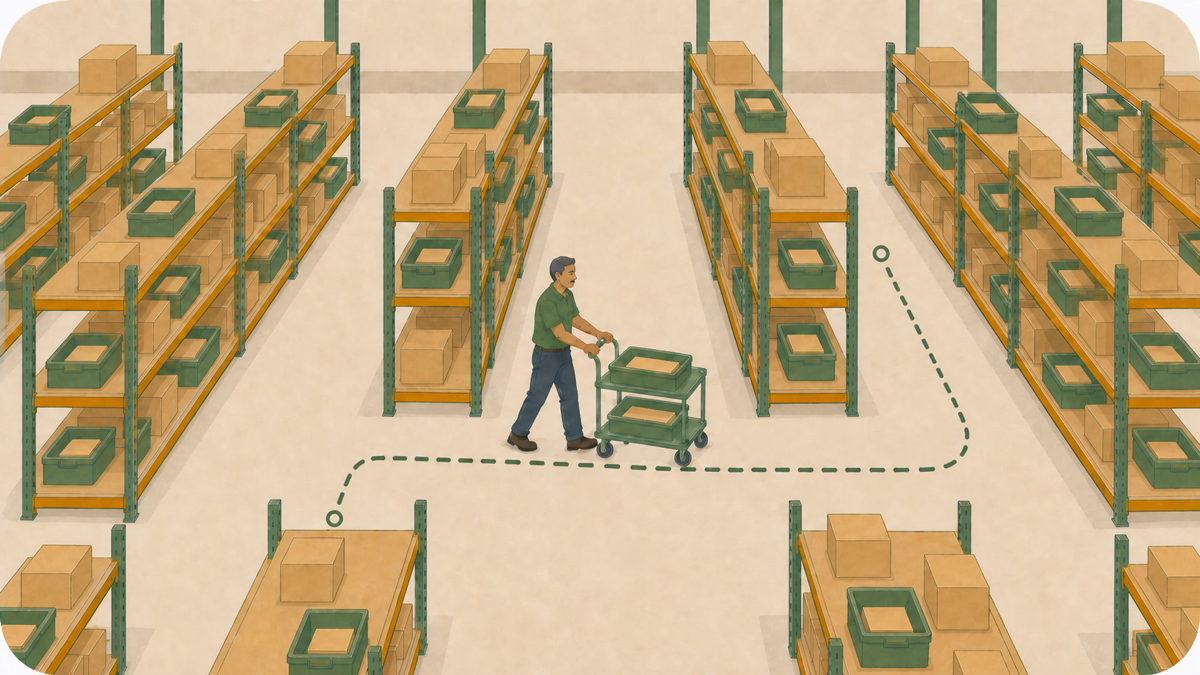
What a cross-aisle changes
A cross-aisle runs across the ends or through the middle of parallel picking aisles. A middle cross-aisle divides long rows into shorter blocks and gives a picker another place to move between them.
The extra connection does not shorten every route. Its value depends on where pickers start and finish, aisle lengths, item locations, and the combinations of locations visited by each order. A proposed opening is worth investigating when routes regularly travel to an existing cross-aisle and then double back to reach picks on the other side of the same storage block.
Account for the space used by the shortcut
A new passage cannot simply be drawn across occupied rack positions. Bays may need to be removed or rows shortened, and the inventory stored there must move somewhere else. If frequently picked products are displaced to less convenient locations, part of the route saving may disappear.
The passage also becomes an intersection. Its practical design should account for the people and equipment using it, including clearance, visibility, turning space, direction rules, pedestrian and vehicle separation, and access to emergency routes. These considerations belong in the proposed layout rather than being left until after a promising distance result.
Use orders that expose the decision
Start with historical orders from a representative operating period. The sample should reflect where picking work occurs across the storage block, not merely include the largest orders. If the order mix changes materially by season, compare those periods separately.
Use the same order set for the current and proposed layouts. That keeps the comparison focused on the aisle change. It also prevents an unusually easy or difficult group of orders from making one layout appear better for the wrong reason.
Compare the complete layout alternatives
SolvingMaze Warehouse Layout Simulation uses a warehouse layout, item locations, and historical orders to calculate pick routes and travel distance. A focused comparison can follow four steps:
- Model the current racks, aisles, pick start and return points, allowed aisle directions, and item locations.
- Run the historical orders and retain the current travel-distance result as the baseline.
- Create the proposed cross-aisle and relocate any inventory displaced by the opening.
- Run the same orders again, then compare the result with the baseline and with other plausible cross-aisle positions.
Use the travel-distance comparison alongside the storage positions lost, relocation work, replenishment flow, and traffic design. The distance difference provides a basis for estimating potential walking reduction; the warehouse can then decide whether that improvement warrants the physical change.
Compare a slotting change as another option
If much of the detour comes from a small group of frequently picked products, relocating those products may improve routes without removing rack bays. Test that alternative with the same historical orders as well. The earlier article on product slotting explains why item placement and layout should be considered together.
A cross-aisle earns serious consideration when the route improvement remains useful after displaced inventory and operating requirements are included. Comparing the alternatives before moving racks turns a visually appealing shortcut into a decision based on the orders the warehouse actually fulfills.
Want to see how the comparison works? Create a free Sandbox Warehouse and try Warehouse Layout Simulation with a small example. When you are ready to evaluate your own operation, set up a Production Warehouse.
 Previous Article